The 9 Hats You Wear as a Leader
Why the psychological gymnastics of leadership are harder than any business strategy — and what your
There is a conversation I have with almost every business leader, entrepreneur, and senior manager I work with. It doesn't start with strategy. It doesn't start with goals. It starts with exhaustion.
Not physical exhaustion — though that's often part of it. It's the exhaustion that comes from having to become a different person, sometimes five or six times a day, and pretending that each transition is seamless. That moving from a fundraising pitch to a redundancy conversation to a finance review to picking your kids up from school is just "part of the job." That all you need is a good diary system and maybe a bit of mindfulness and you'll be fine.
You won't be fine. Not because you're weak, but because nobody taught you how to manage your own mind at the level these transitions demand. And until you learn how, you will keep bumping into the same walls — procrastination, avoidance, guilt, defensiveness, overwhelm — and you will keep thinking the problem is the situation, when the problem is almost always the transition.its.
Let me explain what I mean.
The Hats
I recently worked with a client — a senior leader in a complex, people-heavy organisation — who was struggling. Not with competence. Not with intelligence. Not with ambition. He was struggling with the sheer psychological cost of becoming the right version of himself at the right time.
Together, we mapped out the different "hats" he had to wear in his role and in his life. Everyone's list is different. Everyone's strengths and weaknesses sit in different places. But his list will resonate with most leaders reading this, because the underlying challenge is universal.
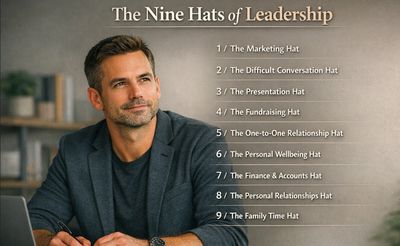
Here are the nine hats he identified.
The Marketing Hat. "How do I tell our story clearly and attractively?" This is the hat of narrative, of clarity, of making something complex feel simple and compelling. It requires creativity, confidence in the message, and a willingness to put yourself and your organisation out there.
The Difficult Conversation Hat. "I can be direct, kind, and honest when something needs addressing." This is the hat most people take off too quickly — or never put on at all. More on this shortly.
The Presentation Hat. "I step up, hold the room, and communicate with confidence." The public-facing hat. The one where you perform authority and clarity under the gaze of others, sometimes with very high stakes attached.
The Fundraising Hat. "I advocate for the mission and secure the resources we need." This hat requires you to ask — sometimes to beg — while maintaining dignity and conviction. It is deeply uncomfortable for many leaders who were raised to believe that asking for money is somehow shameful.
The One-to-One Relationship Hat. "I tune in to individuals, understand their needs, and support their growth." This is the mentoring hat, the coaching hat, the "I see you" hat. It demands presence, patience, and genuine empathy — which is hard to access when you've just come out of a finance meeting where the numbers don't add up.
The Personal Wellbeing Hat. "I protect my health, energy, and stress levels so I can function at my best." This is the hat that most leaders treat as optional. It sits at the bottom of the pile, dusty and neglected, until the body or the mind forces it onto their head through illness, burnout, or breakdown.
The Finance and Accounts Hat. "I stay grounded in the numbers and make decisions that keep us stable." Analytical, precise, sometimes ruthless. A completely different mode of thinking from the relational or creative hats, and one that many right-brained leaders find draining or anxiety-inducing.
The Personal Relationships Hat. "I show up fully for the people who matter in my life." This hat asks you to stop being a leader and start being a human — a partner, a friend, a sibling, a son or daughter. It asks you to be vulnerable in ways that the business world actively discourages.
The Personal Time Hat. This is the one where you shed the business persona entirely. Where you step back into warmth, into softness, into being a parent or a partner without the armour. Where "switching off" isn't just a phrase but an actual psychological act of letting go.
The Hat You Avoid
When we looked at this list together, one hat stood out immediately. Not because it was the biggest part of his role, but because it was the one causing the most damage through avoidance.
The Difficult Conversation Hat.
This is the hat that most leaders I work with struggle with the most, and it is the one where the cost of avoidance is highest. Not just to the leader, but to the people around them — the very people they are trying to protect by avoiding the conversation in the first place.
Here is what typically happens. You work closely with someone. You socialise with them. You build a relationship over weeks or months. And then something changes — funding is cut, performance isn't where it needs to be, a role is no longer viable, a project that someone has poured years of their life into has to end. A difficult conversation needs to be had.
And you don't have it. Not today. Not this week. Maybe next week, when the timing is better. Maybe after the next review cycle. Maybe someone else should do it — someone from HR, someone more senior, someone who is "better at this sort of thing."
The delay is not strategic. It is avoidance. And it is driven not by the situation, but by what is happening inside your own mind.
Here is what my client discovered when we worked together, and it is something I see again and again. The guilt you feel about having that conversation — the discomfort, the dread, the sick feeling in your stomach — does not make you more compassionate. It makes you less effective. It makes you defensive. It makes you rush through the conversation to get it over with. It makes you avoid eye contact. It makes you use corporate language instead of human language. It makes you focus on your own discomfort instead of the other person's experience.
And here is the part that really matters. When you are drowning in your own guilt, your own defensiveness, your own overwhelm at having to deliver bad news, you cannot step into the other person's shoes. You cannot truly empathise with what they are going through. You cannot give them the conversation that a real leader — the leader you want to be — would give them in that moment.
You fail them. Not because you don't care, but because your own emotional noise is so loud that you can't hear what they need from you.
Or worse — you don't feel good enough to have the conversation at all, so you delegate it to someone who doesn't have the relationship, doesn't have the context, doesn't have the authority to do it with the gravity and the grace it deserves. And you fail that person even more profoundly, because in their most difficult professional moment, the person who should have been there for them wasn't.
Why the Usual Approaches Don't Work Here
You might be thinking: "I've done leadership training. I've read the books. I've watched the videos." And I'm sure you have. But here is the problem with conventional approaches to mindset change.
Most self-help, most coaching, most leadership development operates at the level of the conscious mind. It gives you frameworks, scripts, affirmations, breathing techniques, reframes. And all of those things have value — I would never dismiss them. But they all rely on the same assumption: that you can think your way into a different emotional state.
Sometimes you can. When you're rested, when the stakes are low, when you've had time to prepare, you can consciously override your discomfort and perform the version of yourself that the situation requires. But when you're tired, when you're ill, when you're hungry, when the conversation lands on you unexpectedly, when you've had a bad night's sleep or a row with your partner or the anxiety has been building for days — the conscious techniques fall apart. And the old patterns come flooding back.
This is because the patterns don't live in your conscious mind. They live deeper. They live in the subconscious, and they were installed a long time ago — often in childhood, often through experiences you may not even consciously remember. An initial sensitising event, as it is known in my field, is the moment when an emotional pattern was first created. A subsequent sensitising event reinforces it. And by the time you're a forty-five-year-old CEO sitting across the table from someone whose funding you have to cut, you're not just dealing with this conversation. You're dealing with every experience your subconscious has filed under "guilt," "conflict," "rejection," "not good enough," and "letting someone down" — going all the way back to the very first one.
That is why a Post-it note on your mirror that says "I am a confident leader" doesn't work. It's not that the affirmation is wrong. It's that your subconscious has decades of evidence that says otherwise, and it will win that argument every single time..
A Different Approach: Working With the Subconscious, Not Against It
What I do is different from coaching. It is different from therapy in the traditional sense. It is a structured, practical, learnable set of advanced mind management techniques that allow you — or allow me on your behalf — to access the subconscious mind directly, identify the root cause of the pattern that is getting in your way, and change it at source.
This is not mystical. It is not mysterious. It is not "woo." It is a disciplined, repeatable process that I have used with business leaders, entrepreneurs, senior managers, and IT leaders across industries. And once you understand how it works, it changes everything — not just the difficult conversations, but every hat on your list.
When the guilt that sits underneath your avoidance of difficult conversations is resolved at its root, you don't need to "push through" the discomfort anymore. The discomfort isn't there. You can put the Difficult Conversation Hat on and have that conversation from a place of genuine empathy — not empathy that you're performing while your insides churn, but real empathy, because you're no longer consumed by your own emotional response. You can be fully present for the other person. You can give them the conversation they deserve — direct, kind, honest, and human. The conversation that a true leader gives in that moment.
And the same principle applies to every other hat on the list. The fundraising hat becomes easier when the subconscious belief that asking for money is shameful has been tracked down and dealt with. The presentation hat becomes natural when the fear of judgement has been resolved at its source. The personal time hat becomes genuinely restorative when you're no longer carrying the unprocessed weight of every difficult interaction from the day.
How It Works in Practice
I have built an eight-week training course specifically for leaders who want to learn these techniques for themselves. It is designed so that by the end, you have direct access to your own subconscious mind and the practical skills to use that access to identify root causes, deal with the emotions and thought processes that are driving your unwanted patterns, and make lasting changes to your mindset.
The course begins with a one-to-one session where I guide you into a state of deep relaxation and establish what is called an involuntary muscle response — a reliable, verifiable way for your subconscious mind to communicate with you directly. You practise this on your own using a recording of our session together, and this practice becomes the foundation for everything that follows.
From there, the group training sessions build systematically. You learn what the subconscious mind is and how it operates. You learn why these techniques are safe and how the state of deep relaxation works as a bridge between your conscious and subconscious mind. You learn why conventional positive thinking sometimes backfires — why positive suggestions can actually become negative when they conflict with deep subconscious programming — and why all those self-help books and videos you've consumed over the years can suddenly take on a completely new power once you understand how to work with your subconscious rather than against it.
You learn how to talk to your own subconscious mind. How to increase your responsiveness. How to reduce the subconscious blocking that can get in the way of self-directed work. You learn about "the promise" — a concept that is central to this work and one that, once understood, you should never break.
You learn age regression techniques, thought flow diagrams, non-directive questioning, and how to formulate the key questions that allow you to track down the initial sensitising event — the root cause of the pattern you want to change. You learn how to know when you've found it, how to distinguish it from subsequent reinforcing events, and what to do once you're there.
You learn how to make changes at the subconscious level. How to create a place to rescue your younger self. How to use the wisdom of your older self — "I wish I had known then what I know now" — as a tool for renegotiating with your own subconscious. How to deal with trauma at the root event. How to work with the fundamental question of what came first, the emotion or the thought, and how to address both.
And you learn about blocks — why the subconscious creates them, how to use them to your advantage, how to recognise when you're in deep water, and how to work with belief systems at a structural level.
By the end of the eight weeks, you are not dependent on me. You have the skills, the access, and the understanding to continue this work on your own, for whatever challenge or transition or mindset shift your life and your leadership demands next.
Two Ways to Work with Me
There are two paths, depending on what suits you best.
The first is one-to-one work, where I do the heavy lifting with you. We identify the patterns, track down the root causes, and make the changes together. This is the faster route for people who have a specific and pressing issue — a conversation they've been avoiding, a transition they can't seem to make, a version of themselves they know they need to become but can't seem to access when it matters.
The second is the eight-week course, where I teach you the techniques so that you can do this work for yourself, on your own terms, for the rest of your life. This is the route for people who want autonomy — who want to understand their own mind at a level that most people never reach and have the tools to manage it proactively, not reactively.
Either way, it starts with a conversation. Not a sales pitch. A conversation — about where you are, what's getting in the way, and whether this approach is the right fit for what you need.
The Leader You Want to Be Is Already in There
I want to leave you with this thought, because it matters.
The version of you that can have that difficult conversation with grace and empathy — that version already exists. The version of you that can switch hats without fighting yourself, that can be present as a parent five minutes after closing a deal, that can fundraise without shame and present without fear and make hard financial decisions without spiralling — that version is already in you.
It's not something you need to build from scratch. It's something you need to unblock.
The subconscious mind is extraordinarily powerful, and most of us spend our entire lives either ignoring it or fighting it. When you learn to work with it — to listen to it, to communicate with it, to negotiate with it — everything changes. Not in a dramatic, overnight way, but in a way that is deep, structural, and lasting.
You stop having to perform confidence and start feeling it. You stop white knuckling your way through difficult moments and start moving through them with clarity. You stop dreading the hat changes and start making them fluidly, because the internal resistance that was making them so exhausting has been resolved at its source.
That is what I do. That is what this course teaches. And if any part of what you've read here has resonated — if you've recognised yourself in the avoidance, the guilt, the hat you keep taking off too soon — then I'd like to have that conversation with you.
Book a call. Let's talk about which hat is giving you trouble, and what we can do about it.